Compact 3D Printer Review for Small Workspaces
A compact printer can earn its place beside a gaming setup, home office, or workshop bench faster than almost any other piece of creator tech. This compact 3d printer review focuses on what matters after the unboxing: whether a smaller machine can deliver clean parts, dependable repeat prints, and a workflow you will actually want to use.
The short answer is yes, provided you buy for the projects you plan to make rather than simply the smallest footprint. Compact 3D printers have become remarkably capable, with features once reserved for larger enthusiast machines: automatic bed leveling, heated build plates, enclosed print chambers, high-speed motion systems, and polished slicer software. The trade-off is straightforward. You save valuable floor space, but you give up some build volume and, depending on the model, access to certain advanced materials.
For makers producing tabletop accessories, replacement parts, controller stands, miniatures, prototypes, storage organizers, and custom accessories, that is often a smart trade.
Compact 3D Printer Review: The Real Performance Test
A small printer should not be judged as a reduced version of a large machine. It should be judged on how well it turns limited workspace into useful output. The best compact models feel intentional: they heat quickly, level reliably, recover from routine mistakes, and produce parts that need little cleanup.
Print quality begins with motion control and a stable frame. Fast marketing claims are easy to find, but speed only matters when the printer maintains accurate dimensions, smooth walls, and clean overhangs. A compact unit with a rigid metal frame and well-tuned profiles can often produce better-looking parts than a larger printer that demands constant adjustment.
Look closely at the first layer, because it tells you a great deal about the experience ahead. A printer with dependable automatic bed leveling and a quality flexible build plate removes one of the most common frustrations for new owners. It also makes removal easier, especially for broad flat parts such as brackets, trays, and display bases.
Consistency matters more than a single impressive benchmark print. If you are creating a set of matching drawer organizers, a batch of terrain pieces, or several iterations of a prototype, the machine needs to repeat the result without a fresh calibration ritual every time. That is where better sensors, refined firmware, and thoughtful filament handling justify a premium purchase.
Size Is More Than Build Volume
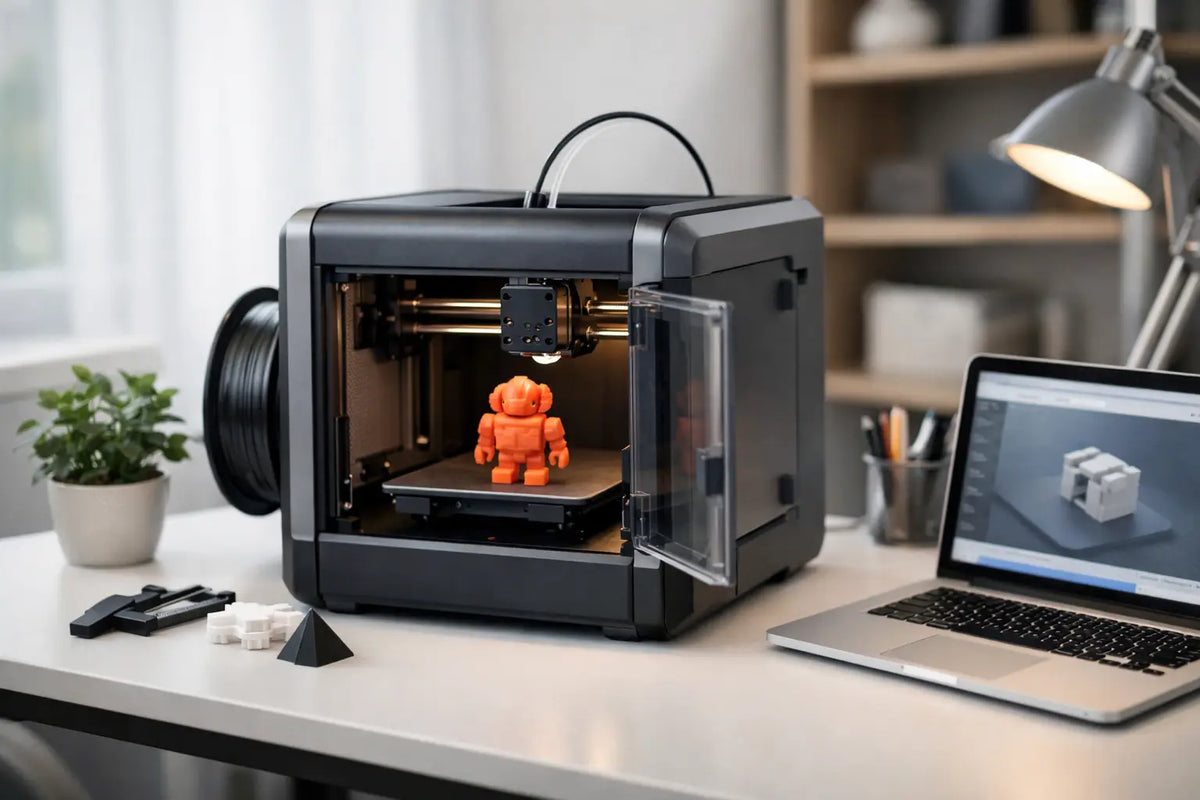
Build volume is the obvious specification, but it is not the whole space calculation. A compact 3D printer may fit on a desk while still requiring room for a filament spool, a moving bed, a top-mounted feeder, ventilation, tools, and safe access to the rear or side panels.
Before buying, measure the printer's operating footprint, not just its listed dimensions. Bed-slinger designs need clearance in front and behind as the build plate moves. CoreXY-style machines often keep their movement contained within the frame, making them especially appealing for shelves, desks, and maker stations where every inch counts. An enclosed machine may occupy more vertical space, yet it can be easier to position neatly and can help manage drafts, sound, and curious pets.
For most home creators, a build area around 6 to 10 inches on each axis handles a surprising range of work. Phone docks, drone accessories, headset hooks, board-game inserts, camera mounts, small household repairs, and gaming display pieces rarely require a massive print bed. When a project does exceed the volume, it can often be split into interlocking sections. That adds assembly time, but it is usually preferable to giving up half a workbench for a printer used occasionally.
Materials Separate Good Choices From Great Ones
PLA is the natural starting point for nearly every compact machine. It is affordable, visually versatile, easy to print, and ideal for models, organizers, décor, and many light-duty functional pieces. A printer that handles PLA beautifully is already capable of supporting a great deal of creative work.
If your projects will live in a car, garage, outdoors, or near heat, material capability becomes more important. PETG offers greater durability and heat resistance for many practical parts, although it can be more prone to stringing. TPU opens the door to flexible phone mounts, protective feet, and custom grips, but it benefits from a controlled filament path and patient tuning.
ABS, ASA, nylon, and carbon-fiber-filled materials are a different category. They can create tougher, more heat-resistant parts, but they demand more from the machine and the workspace. Enclosures help retain heat for warp-prone filaments, while hardened nozzles are often needed for abrasive composite materials. If these materials are central to your workflow, do not choose a compact printer solely because it fits your desk. Choose one designed for them, and plan for appropriate ventilation.
A common buying mistake is paying for high-end material compatibility that will never be used. Another is buying an open, entry-oriented printer for engineering-style projects that need an enclosure and hardened components. The right choice depends on the finish, strength, and environment your final parts require.
Setup Experience Matters More Than It Sounds
A printer can have excellent hardware and still become frustrating if the setup is unclear or the software feels unfinished. Premium compact machines increasingly reduce the barrier with guided setup, automatic calibration, built-in cameras, filament runout detection, and preconfigured material profiles.
Those features are not just conveniences. They protect your time. A runout sensor can save a long print when a spool empties overnight. A camera can let you check progress from another room. Well-tested slicer profiles reduce the trial-and-error that once made 3D printing feel like a hobby for tinkerers only.
That said, no printer is completely hands-off. You will still need to keep the build plate clean, dry filament properly, inspect nozzles, and learn basic support settings. The best beginner-friendly printer is not one that hides every setting. It is one that delivers strong default results while giving you room to grow when a custom project calls for more control.
For a shared household or busy workspace, also consider noise. Smaller printers can still be loud during fast movements, especially with open frames. Enclosed designs and modern stepper drivers can make a meaningful difference, but placement remains important. A sturdy cabinet, workbench, or purpose-built cart will produce better results than a wobbly desk.
Who Should Buy a Compact Printer?
Compact machines are an excellent fit for apartment makers, first-time owners, students, gamers building custom accessories, and professionals who need quick prototype capability near their desks. They also work well as a second printer for an established maker who wants to dedicate a machine to small, frequent jobs.
They are less ideal for anyone regularly printing large helmets, full-size cosplay components, oversized architectural models, or production runs of big functional parts. Those projects are possible with segmented prints, but larger build volume makes the process simpler. If you expect to outgrow a small platform quickly, investing in a mid-size enclosed printer may be the better value.
At Your Tech Haven, the strongest compact-printer choice is the one that matches the rest of your tech lifestyle. A creator making tabletop upgrades has different needs from a drone enthusiast designing mounts or a home-office professional prototyping a product idea. Start with the parts you want to make in the next six months, then select the footprint, materials, and automation that support those projects.
A Smart Pre-Purchase Check
Before you commit, confirm that the printer has enough build volume for your largest routine project and that its operating clearance fits the intended location. Check the materials you want to use, whether the nozzle and enclosure support them, and how easy it is to get replacement consumables. Consider the software experience, noise level, and whether you want features such as a camera, automatic leveling, and filament detection.
Most of all, buy a machine you will feel comfortable using often. A compact 3D printer becomes genuinely valuable when it is close at hand, loaded with filament, and ready to turn the next good idea into something you can hold.