What 3D Printer Nozzle Size Should You Use?
A nozzle is a small part with an outsized effect on every print. It determines how much molten filament your printer can place in one pass, which changes print time, visible detail, wall strength, and even how forgiving the setup feels. The question of what 3D printer nozzle size to choose is really a question of what you want your machine to do most often.
For most makers, the standard 0.4 mm nozzle is the right starting point. It delivers a capable mix of detail, speed, and material compatibility. But if you are printing miniatures, functional brackets, cosplay parts, workshop fixtures, or large prototypes, a different nozzle diameter can make your 3D printer feel like a better tool for the job.
What 3D Printer Nozzle Size Means
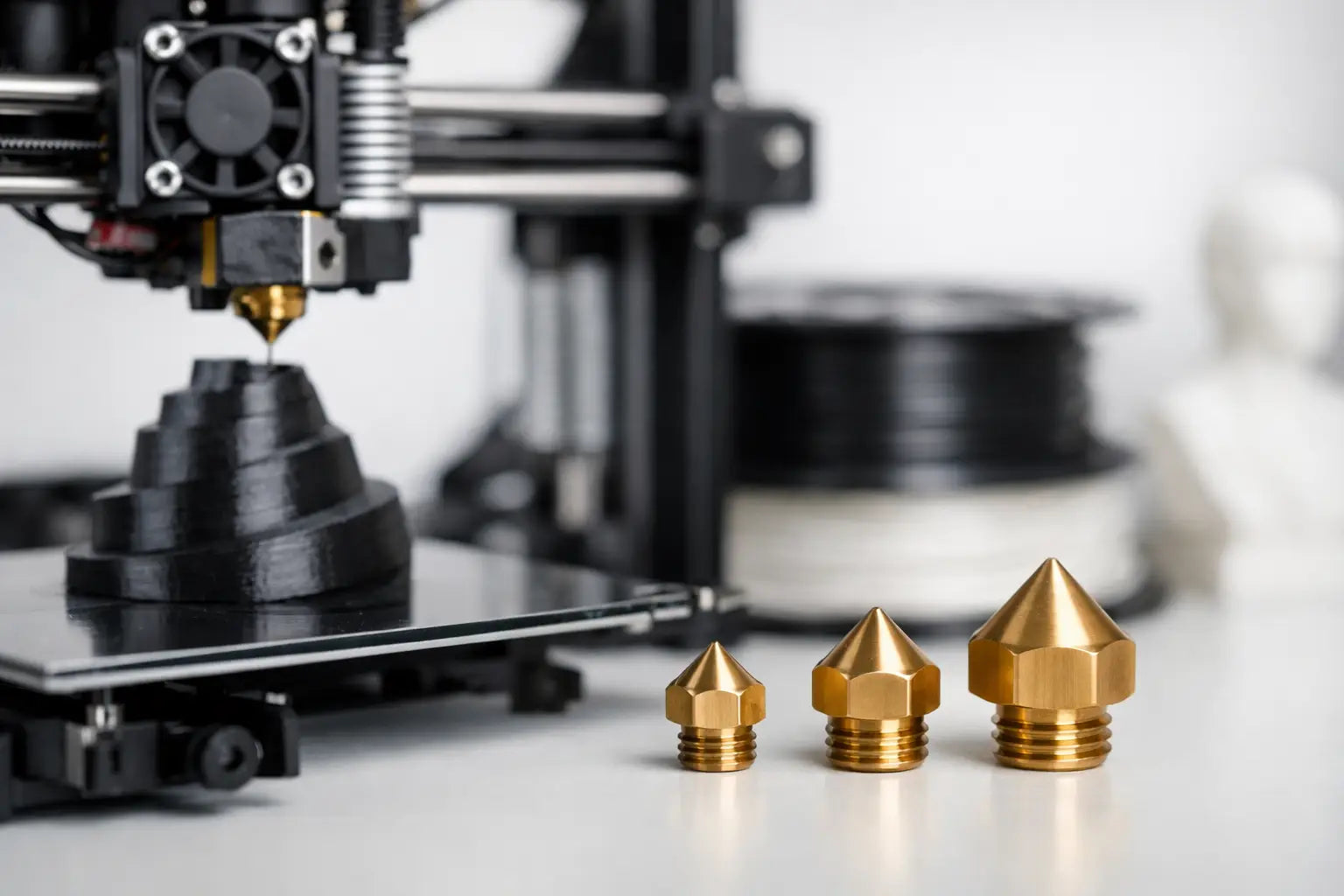
Nozzle size refers to the diameter of the opening at the tip of the nozzle. A 0.4 mm nozzle has an opening that is 0.4 millimeters wide. That opening controls the width of each extruded line of filament, also called an extrusion line or bead.
A smaller opening produces narrower lines, allowing the printer to capture finer surface features. The trade-off is that it lays down less plastic with each movement, so prints take longer. A larger opening produces wider lines that fill a model faster and create more substantial walls, but tiny details can soften or disappear.
Nozzle diameter is not the same as layer height, although the two work together. Layer height affects the vertical resolution of a print, while nozzle size affects the width of the printed lines. As a useful rule, the maximum practical layer height is usually about 70 to 80 percent of nozzle diameter. A 0.4 mm nozzle commonly prints well at 0.12 to 0.28 mm layers, while a 0.6 mm nozzle can comfortably run thicker layers for faster, more durable parts.
The 0.4 mm Nozzle: The Smart Default
The 0.4 mm nozzle comes standard on most consumer FDM printers for a reason. It handles PLA, PETG, ABS, TPU, and many filled filaments while producing clean, detailed parts without painfully long print times.
For desk organizers, replacement household parts, game accessories, enclosure components, and general prototypes, 0.4 mm is hard to beat. It also provides the broadest selection of proven slicer profiles, making it a confidence-building choice for newcomers and a dependable daily driver for experienced makers.
If you only plan to own one nozzle, choose 0.4 mm. Invest your time in dialing in temperature, bed adhesion, and filament quality before chasing extreme resolution or maximum throughput. Those fundamentals will improve your results more than a nozzle swap alone.
What 3D Printer Nozzle Size Is Best for Detail?
For high-detail prints, a 0.2 mm nozzle is the specialist choice. Its narrow extrusion lines can better define small lettering, fine texture, miniature faces, model terrain features, jewelry prototypes, and intricate mechanical components.
The benefit comes with real limitations. A 0.2 mm nozzle is much slower than 0.4 mm because it can move less material at a time. It is also more likely to clog, especially with dusty filament, glitter additives, wood fill, carbon fiber fill, or inconsistent filament diameter. Small nozzles reward careful filament storage, clean feeding paths, and patient slicer tuning.
A smaller nozzle does not automatically make every model look better. Fine detail only helps when the model itself contains fine features and the printer is mechanically calibrated well enough to reproduce them. For a large helmet, planter, or storage bin, the added time is rarely worth it.
When a 0.6 mm Nozzle Makes Sense
A 0.6 mm nozzle is one of the most valuable upgrades for makers focused on practical printing. It can reduce print times dramatically without making ordinary parts look noticeably rough. For many functional pieces, the visual difference from 0.4 mm is modest, especially when using a 0.2 or 0.24 mm layer height.
The wider extrusion lines also create stronger parts. With fewer lines needed to form a wall, the layers have more contact area and can fuse more effectively. That makes 0.6 mm a compelling option for tool holders, camera mounts, drone accessories, workshop jigs, RC components, and large home projects.
It is also a better match for abrasive composite filaments. Carbon fiber, glass fiber, wood-filled, and glow-in-the-dark materials are less likely to clog a 0.6 mm opening than a 0.4 mm one. Pair abrasive filament with a hardened steel, tungsten carbide, or similar wear-resistant nozzle. A standard brass nozzle can wear quickly, changing its effective diameter and reducing print precision.
The main compromise is detail. Sharp text, small holes, thin walls, and intricate geometry may need to be redesigned or printed with a smaller nozzle. A 0.6 mm nozzle is about smart throughput, not microscopic precision.
Use 0.8 mm and Larger for Big, Strong Parts
A 0.8 mm nozzle is built for momentum. It excels at large-format prints where speed and durability matter more than a polished surface finish: full-size props, furniture components, bins, shop fixtures, molds, and oversized prototypes.
With the right hotend, heater, and slicer settings, a 0.8 mm nozzle can turn an all-day print into a project measured in hours. The parts can be exceptionally sturdy because of their thick extrusion lines and fewer internal seams.
However, bigger is not always faster by default. Your printer's hotend must melt filament quickly enough to supply the larger nozzle. This is called volumetric flow capacity. If the hotend cannot keep up, pushing the speed too far can cause under-extrusion, weak layers, and inconsistent surfaces. Larger nozzles may also require slower movement than expected when printing high-temperature materials.
Before switching to 0.8 mm, confirm that your printer supports the nozzle type and diameter. Then begin with a conservative slicer profile rather than simply increasing print speed.
Nozzle Size, Material, and Printer Capability
The ideal nozzle depends on more than the model. Filament type matters. Standard PLA and PETG work well through 0.4 mm and 0.6 mm nozzles. Flexible TPU often benefits from thoughtful speed control more than a larger nozzle, though 0.6 mm can be helpful for thicker, functional flexible parts.
Filled filaments need extra consideration. Materials containing fibers, wood particles, metal particles, or other additives flow less predictably than plain filament. A 0.6 mm hardened nozzle is often the safer, more reliable combination. It gives particles more room to pass while protecting the nozzle from abrasion.
Your printer's motion system and hotend also set practical limits. A premium high-flow hotend can take full advantage of a 0.6 or 0.8 mm nozzle. A basic hotend may deliver better results by using a larger nozzle at moderate speeds and thicker layers, rather than trying to force extreme flow rates.
How to Choose Your Nozzle Size
Start with the kind of projects you print most, not the most impressive specification on a product page. A miniature painter who values crisp facial features should prioritize 0.2 mm. A creator producing a mix of accessories, prototypes, and display pieces should stay with 0.4 mm. A workshop maker or prop builder will likely get more value from 0.6 mm. For large, rugged prints where time matters, 0.8 mm can be a game-changer.
Keep in mind that nozzle swaps involve more than installing a new tip. You need to select the correct nozzle diameter in your slicer, adjust layer height and line width, and retune temperature or flow if necessary. Run a small calibration print before committing to a long project. This simple step can prevent hours of wasted filament.
For many enthusiasts, owning both 0.4 mm and 0.6 mm nozzles is the most flexible setup. Use 0.4 mm when appearance and detail lead the project, then move to 0.6 mm when you need stronger parts and faster production. It is a practical way to make one 3D printer ready for both creative weekends and serious workshop tasks.
The best nozzle is the one that matches the result you want to hold in your hands. Choose for the project in front of you, tune with intention, and your printer will deliver far more than a one-size-fits-all setup ever could.