How to Start Sim Racing the Smart Way
A lot of people get interested in sim racing the same way - one great lap, one too-close overtake, and suddenly a controller on the couch no longer feels like enough. If you are wondering how to start sim racing, the good news is that you do not need a professional-grade cockpit on day one. You do need a smart plan, the right priorities, and gear that matches the kind of driving experience you actually want.
Sim racing can be as casual or as serious as you make it. That is part of the appeal. You can start with a modest setup and build toward a more immersive rig over time, or go straight for a premium home racing station that feels like a dedicated motorsport corner in your space. The key is understanding what matters most at the beginning so you invest once, upgrade with purpose, and enjoy the process from your first session.
How to Start Sim Racing Without Overspending
The biggest mistake beginners make is assuming they need everything at once. They buy for the dream setup instead of the setup they will actually use this month. A better approach is to think in layers: platform, controls, seating, and upgrades.
Your platform is the foundation. Some people start on console because it is simpler and familiar. Others go with PC because it offers broader simulator choice, more tuning options, and a longer performance runway. Neither is automatically better. If you want convenience and a cleaner path into racing games, console can be a strong start. If you care about flexibility, graphics tuning, and more advanced sim ecosystems, PC usually wins.
Then come the controls. This is where sim racing starts to feel different from standard gaming. A force feedback wheel and pedal set change everything because they let you feel grip, weight transfer, curbs, and loss of traction in ways a controller cannot. If your budget is limited, this is usually the first place to spend with intention.
Seating matters more than many beginners expect. A wheel clamped to a desk can work, especially early on, but it has limits. Flex, poor pedal placement, and an awkward chair can make consistent driving harder than it should be. A stable racing seat or cockpit adds comfort, repeatability, and immersion, which becomes increasingly important as your sessions get longer and your lap times start to matter.
Start with the right sim racing gear
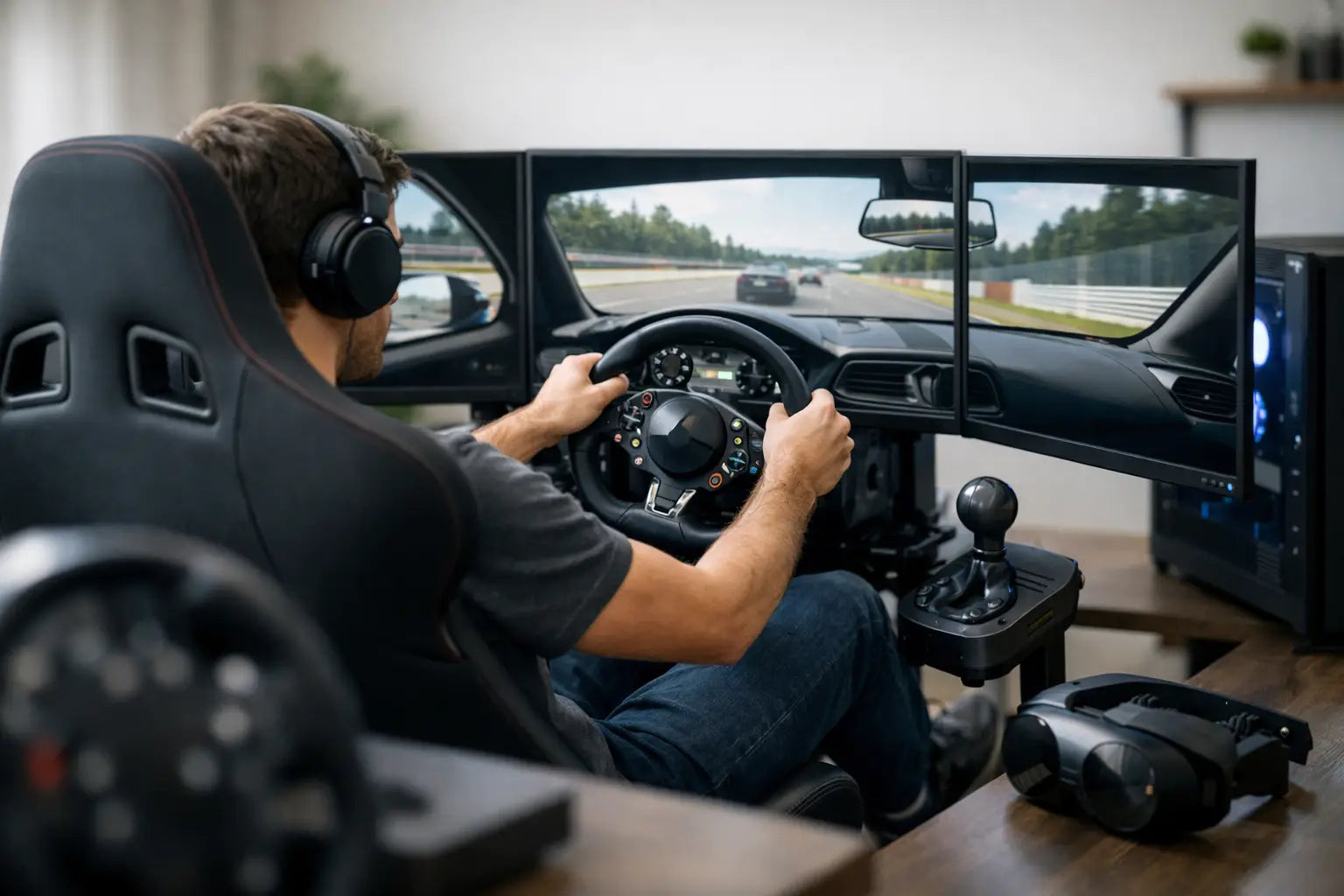
If you want the shortest path to a satisfying setup, focus on three essentials: a wheelbase and wheel, pedals, and a stable place to mount everything. Everything else is optional at first.
A gear-driven or belt-driven wheel can still be a good beginner choice, but direct drive has become far more attractive as more premium consumer options enter the market. It delivers stronger, cleaner, and more detailed force feedback. That does not mean every beginner needs direct drive immediately. It means you should think honestly about how committed you are. If you already know you love racing games and want a setup with room to grow, buying one level higher now can save money later.
Pedals deserve just as much attention as the wheel. Many new drivers focus on steering feel and ignore braking performance, but braking is where consistency lives. A basic two-pedal set can get you on track, yet a better brake pedal often improves confidence more than people expect. If you plan to race often, this is one of the smartest areas to upgrade.
A racing seat or cockpit pulls the whole system together. This is especially true if you are using stronger force feedback. A flimsy setup wastes performance because the rig moves instead of transferring detail to your hands and feet. A dedicated simulator seat also turns sim racing into a true home experience rather than something you need to set up and tear down every time.
Picking the right setup for your budget
There is no single correct entry point, only the right fit for your expectations.
If you want a lower-commitment start, a beginner wheel and pedal bundle mounted to a desk can make sense. It keeps the cost down and lets you decide whether you enjoy practicing laps, learning tracks, and spending time dialing in car behavior. The trade-off is that you may outgrow it quickly.
If you already know you want the full experience, a mid-range or premium rig is often the smarter buy. You get better feedback, stronger build quality, and fewer compromises around comfort and stability. For shoppers who care about elevated home entertainment, this route aligns better with long-term value. It also looks and feels more intentional in a game room, office, or dedicated media space.
Display choice matters too. A single monitor is enough to begin, and many drivers stay there happily. Ultrawide and triple-monitor setups create a more expansive field of view, while VR can deliver unmatched immersion. But each path has trade-offs. Triples take up space and require more setup. VR is thrilling but not ideal for everyone, especially during longer sessions. Start simple unless visual immersion is the top reason you are getting into the hobby.
How to start sim racing with the right games
Not every racing title is built for the same kind of player. Some are more forgiving and game-like. Others are closer to motorsport simulation and demand patience.
If you are brand new, it helps to begin with a title that gives you enough realism to build good habits without making every mistake feel punishing. You want something that teaches braking points, racing lines, and throttle control while still being enjoyable after a long workday. More advanced sims can come next, once you are ready to tune setups, understand tire behavior, and race in more competitive environments.
The smartest move is to pick one or two titles and stay with them for a while. Jumping between too many games can slow your learning because each one handles a little differently. Consistency helps you improve faster.
Set up your space like you plan to keep using it
A sim racing setup is not just about hardware specs. It is also about whether your room supports the experience. If your pedals slide, your chair rolls back, or your monitor sits too high, you will feel it every lap.
Aim for a layout that is comfortable, stable, and easy to use regularly. This is where premium home equipment earns its place. A dedicated cockpit, proper seating position, and clean cable management make the setup feel permanent, which makes you more likely to use it. Convenience drives consistency.
Audio can also elevate the experience. Headphones are the simplest option and often the best for detail. If your space allows it, a quality speaker setup can add impact, especially for a more social entertainment room. It depends on whether you are building a private driving zone or a shared game room with broader appeal.
Learning to drive is part of the fun
Once your rig is ready, resist the urge to judge yourself by lap times immediately. Sim racing has a real learning curve. At first, the fastest gains come from smooth inputs, not aggressive driving.
Brake in a straight line. Get the car settled before turn-in. Roll on the throttle instead of stomping on it at corner exit. These basics sound simple, but they separate controlled laps from chaotic ones. Many beginners try to attack the track too early, which usually makes them slower.
It also helps to treat practice like practice. Run a track repeatedly. Learn where you are losing time. Make one change at a time. In sim racing, progress often feels gradual until suddenly you realize you are seconds faster and much more consistent than you were a week ago.
When to upgrade your sim racing setup
The best upgrades solve a problem you can already feel. If your wheel stand shakes under load, upgrade your mounting solution. If your braking feels inconsistent, improve your pedals. If long sessions leave you uncomfortable, invest in better seating.
That is a much better strategy than buying random accessories because they look advanced. Shifters, handbrakes, button boxes, and motion systems can all be fantastic, but only if they support the kind of driving you actually do. A rally fan has different priorities than a GT racer. A casual weekend driver may care more about comfort and simplicity than maximum realism.
For many buyers, building a premium sim rig is part of a larger home tech vision. It is not just a gaming purchase. It is a statement piece, a performance tool, and a better way to experience racing at home. That is why curated gear selection matters. The right setup should feel future-ready, not temporary.
If you are ready to move beyond trial-and-error shopping, Your Tech Haven is the kind of place where serious gaming and home entertainment buyers can find equipment that matches that bigger vision.
The best way to start is not the cheapest way or the most expensive way. It is the way that gets you driving often, learning steadily, and enjoying every lap enough to come back for the next one.