7 Best 3D Scanners for Small Business
A bad scanner choice usually shows up after the return window closes. You buy for resolution, then realize the workflow is slow, the software is clunky, or it struggles with the parts you scan every day. If you are shopping for the best 3D scanners for small business, the real goal is not just accuracy. It is finding a system that fits your products, your pace, and the way your team actually works.
For a small business, that fit matters more than chasing the most expensive spec sheet. A jewelry brand scanning tiny detailed pieces has very different needs than an auto shop digitizing larger parts, a maker studio building prototypes, or an ecommerce seller creating digital product assets. The strongest pick is the scanner that saves time consistently, produces usable files without constant cleanup, and does not force your team into a steep learning curve.
How to choose the best 3D scanners for small business
Start with object size. Small, high-detail items such as dental models, miniatures, tools, or jewelry usually call for tighter resolution and better fine-feature capture. Larger objects like furniture, body scans, bike frames, or machine parts need a wider capture area and faster scanning speed. Many businesses make the mistake of buying for one showcase use case and ignoring the 80 percent of scanning they will actually do.
Accuracy is the next filter, but it needs context. If you are using scans for reverse engineering, manufacturing checks, or CAD workflows, accuracy has direct business value. If your main use is visualization, ecommerce, or concept development, ease of use and speed may matter more than chasing metrology-level performance.
Software deserves more attention than it usually gets. A scanner can have great hardware and still slow your team down if alignment is finicky, exports are limited, or post-processing takes too long. Good software shortens the distance between scan and usable model. For a small business, that often matters more than a tiny bump in technical specs.
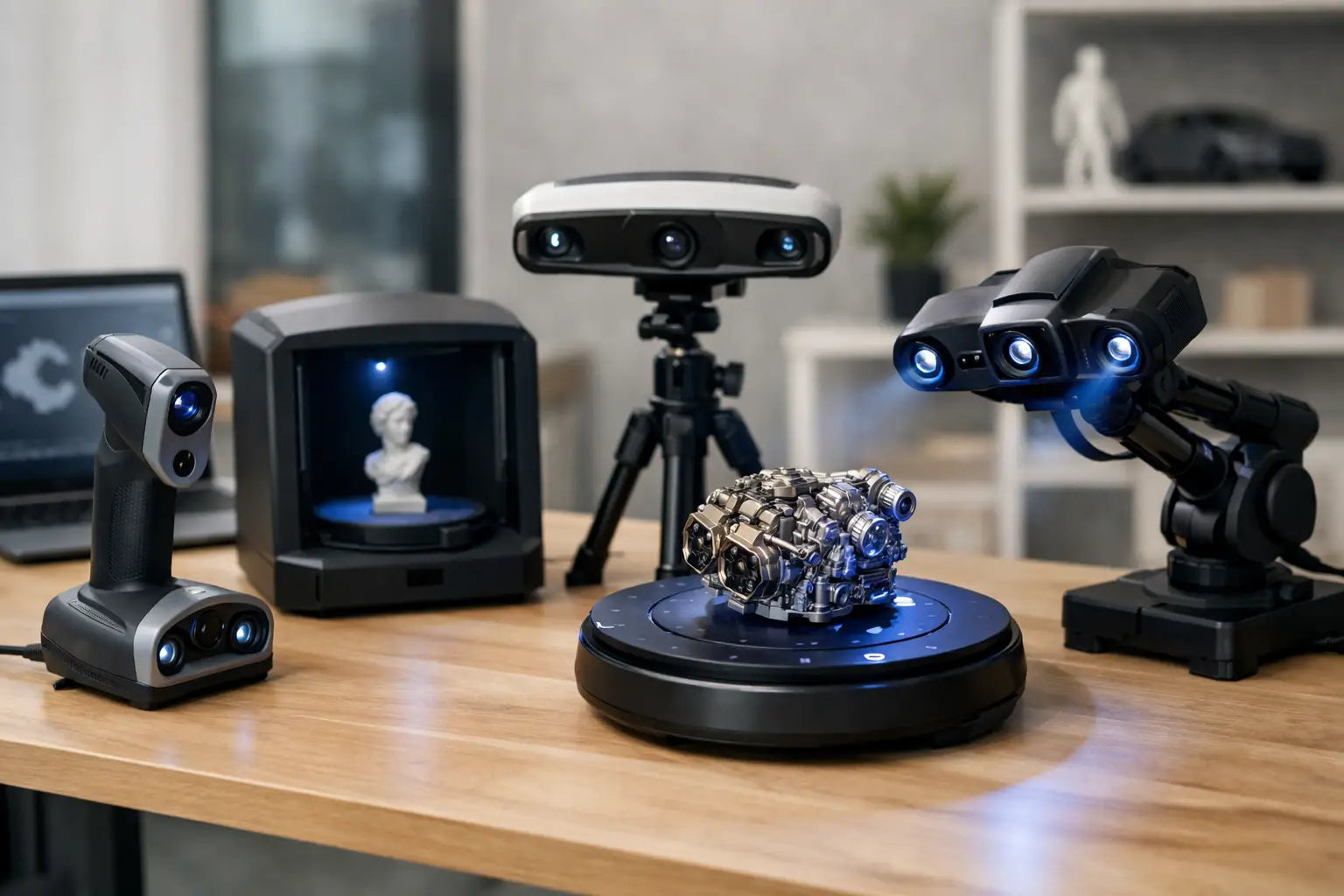
Portability also changes the buying decision. A desktop unit can deliver consistency in a controlled setup, while a handheld scanner gives you freedom for larger objects and field work. Neither is automatically better. It depends on whether you need repeatable bench scanning or flexible all-around capture.
7 picks worth considering
Revopoint MINI 2
If your business works with small objects and fine detail, the Revopoint MINI 2 is an easy model to take seriously. It is especially appealing for makers, product designers, miniature creators, jewelers, and small repair businesses that need sharper scans of compact items.
Its big strength is detail capture on smaller subjects. That makes it a strong fit for parts with edges, textures, and complex geometry that cheaper all-purpose scanners often blur. The trade-off is that it is not the scanner you buy for large objects first. If your workflow frequently jumps from tiny components to furniture-sized items, you may outgrow its ideal range.
Revopoint POP 3
The POP 3 sits in a sweet spot for small businesses that want flexibility without overspending. It is portable, approachable, and useful across a wide range of scanning tasks, from product samples and hobbyist prototypes to medium-size parts and human subjects.
This is the kind of scanner that works well when your business is still defining its 3D workflow. It may not be the most specialized option in any single category, but it brings versatility that many smaller teams need. For entrepreneurs, Etsy-style product brands, and creators building digital assets, that balance can be more valuable than chasing a niche machine.
Einstar
The Einstar has become a popular pick for businesses that want handheld scanning with solid performance and a more professional feel than entry-level devices. It fits well for product design, education, fabrication, cosplay studios, and general-purpose studio use.
What stands out here is user confidence. Many buyers want a scanner that feels like a step into serious 3D capture without becoming intimidating. The Einstar often lands in that middle ground. It handles larger scans more comfortably than compact desktop-focused units, though it may ask for a more deliberate setup and stronger computer hardware to get the best results.
Creality CR-Scan Ferret Pro
For small businesses that want a lower barrier to entry, the CR-Scan Ferret Pro deserves a look. It is attractive for sellers testing 3D scanning for the first time, content creators who want occasional digital capture, and workshops that need a budget-conscious secondary scanner.
The appeal is simple: lower upfront cost, easier adoption, and enough capability for many starter applications. The limitation is just as clear. If your business depends on consistently high-detail scans for engineering or premium client work, this model can feel like a stepping stone rather than a long-term centerpiece.
3DMakerpro Moose
The Moose is a compelling option for businesses that want clean-looking hardware, user-friendly operation, and a workflow that feels modern rather than overly technical. It fits nicely for creative studios, designers, ecommerce teams, and makerspaces where multiple users may need access.
Its value is not only in scan output but in accessibility. When a tool is easier to learn, it gets used more often. That matters in a small business where one person is usually juggling production, marketing, operations, and customer work. The trade-off is that highly technical users with strict industrial demands may want more specialized performance.
Matter and Form THREE
If your business scans smaller items in a fixed workspace, a desktop option like the Matter and Form THREE can make a lot of sense. Desktop scanners are often underrated because they are less flashy than handhelds, but they can be excellent for repeatable capture of product samples, collectibles, crafted goods, and small manufactured parts.
The advantage is consistency. You set the environment, control the object, and reduce the variables that make handheld scanning unpredictable. The downside is flexibility. If your business needs to scan larger objects or work on-site, a desktop system can feel restrictive fast.
Artec Eva
For businesses ready to invest at a higher level, the Artec Eva remains one of the most respected handheld scanners on the market. It is a premium choice for professional design firms, service bureaus, medical applications, museums, advanced prototyping teams, and businesses where scan quality directly affects revenue.
This is not the budget-friendly option, and that is exactly the point. You buy it when scanning is central to your workflow, not occasional. For many small businesses, it will be more scanner than they need. But if your operation is scaling into professional-grade capture and client-facing deliverables, it can justify the price through speed, reliability, and output quality.
Which type of scanner makes the most sense?
For many buyers searching for the best 3D scanners for small business, the real question is not brand first. It is scanner type first.
A handheld scanner is usually the strongest choice if you need flexibility. It works well for mixed object sizes, irregular shapes, and businesses that want to move around the shop or scan on location. If your work includes props, body scanning, automotive parts, or large prototypes, handheld is usually the better path.
A desktop scanner is often better when your business handles smaller items and wants repeatability. If you are cataloging products, digitizing crafted pieces, or building a reliable bench workflow, desktop scanning can be faster and less frustrating over time.
There is also a middle-ground strategy that makes sense for growth-minded businesses. Start with an adaptable handheld scanner if you are still learning your volume and use cases. Move into a specialized second scanner later when your workflow proves where the bottleneck really is.
What small businesses often get wrong
The biggest mistake is buying based on maximum spec claims instead of daily use. Resolution, frame rate, and accuracy numbers look great in product comparisons, but they do not tell you how often a scan will need cleanup, how easy the software is to learn, or whether your team can get repeatable results by the third day.
The second mistake is ignoring computer requirements. Some scanners are only as good as the machine powering them. If your workstation is underpowered, even a strong scanner can feel frustrating.
The third mistake is overlooking what happens after the scan. Ask whether you need STL output for 3D printing, mesh cleanup for product development, or compatibility with your preferred CAD tools. A scanner is not just a capture device. It is the front end of your production pipeline.
The smartest pick depends on your workload
If your business scans small, detailed objects, start with something like the Revopoint MINI 2 or a strong desktop unit. If you need versatility across products and projects, the Revopoint POP 3 or Einstar makes more sense. If budget matters most, the CR-Scan Ferret Pro is a practical entry point. If scanning is becoming a core revenue driver, stepping up to a premium system like Artec Eva may be the right move.
That is the exciting part of this category right now. Small businesses no longer need enterprise budgets to bring 3D capture into design, retail, customization, and prototyping workflows. The best investment is the one that fits your actual operation today while giving you room to build something bigger tomorrow. If you are choosing carefully, that is where future-ready tech starts to pay off.