Drone Camera vs Action Camera: Which Fits You?
The first time you watch a rider carve down a trail from 200 feet overhead, then switch to a chest-mounted shot racing through the same turns, the drone camera vs action camera decision gets real fast. Both can capture spectacular 4K footage. But they create completely different experiences, demand different skills, and fit different kinds of adventures.
A drone changes the viewer’s sense of place. An action camera puts them in the middle of the motion. Choosing well is less about which device has the bigger spec sheet and more about the story you want to tell, where you plan to shoot, and how much setup you want between you and the moment.
Drone Camera vs Action Camera: The Core Difference
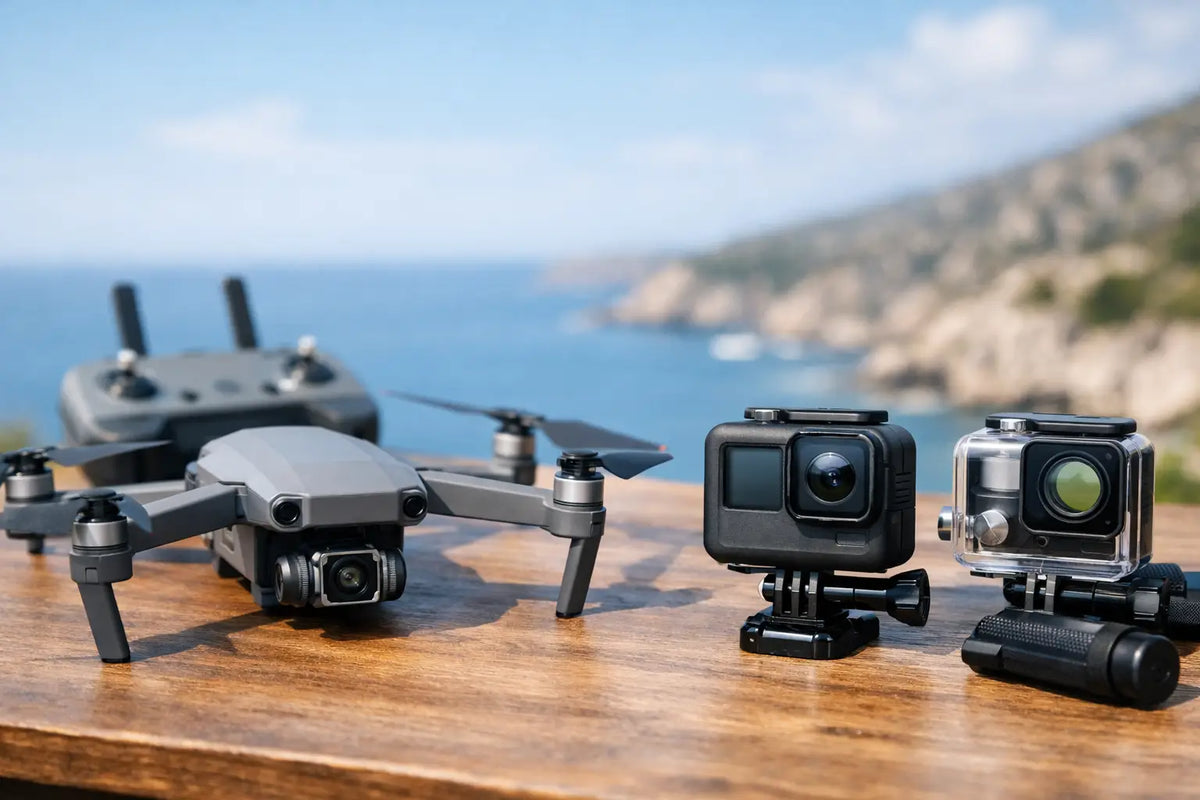
A drone camera is a remote-controlled flying camera system. Its defining advantage is perspective: high establishing shots, smooth tracking moves, overhead angles, and sweeping reveals that would otherwise require a helicopter, crane, or a very tall ladder. Modern camera drones also use stabilized gimbals to keep footage level and polished while the aircraft moves through the air.
An action camera is a compact, impact-resistant camera designed to go where your phone or mirrorless camera should not. Mount it to a helmet, bike, surfboard, chest harness, vehicle, or handheld grip. Its value is proximity. The viewer sees the drop, turn, splash, jump, and acceleration from inside the action rather than above it.
That distinction affects every buying decision that follows. A drone makes the environment feel epic. An action camera makes the activity feel immediate.
Choose a Drone Camera for Cinematic Scale
A drone is the right choice when the location is part of the story. Think mountain ridges, coastlines, ski runs, construction sites, real estate, group rides, campsites, and wide-open travel destinations. Aerial footage can establish scale in seconds, showing a setting in a way ground-level gear simply cannot.
For content creators, drones also add production value without requiring a large crew. Features such as subject tracking, waypoint flights, return-to-home functions, and automated cinematic modes can help one person capture shots that look carefully planned. A quality gimbal is especially valuable for smooth footage during forward flight, orbit shots, and slow reveals.
Still, a drone is not just a camera that happens to fly. It is an aircraft, and that brings responsibility. You need room to take off and land safely, attention to wind and battery life, and awareness of people, wildlife, buildings, and power lines. In the United States, recreational and commercial drone flights are subject to FAA rules, and many locations have additional restrictions. National parks, stadiums, private venues, crowded events, and controlled airspace can all limit where you fly.
A drone also has a larger setup footprint. You may need to check the flight area, connect a controller, wait for GPS, inspect propellers, and plan your shot before launching. That extra effort pays off when the scene calls for it, but it can be the wrong tool for a quick run, ride, or family outing.
Choose an Action Camera for Immersive POV
Action cameras thrive when the camera needs to be tough, light, and ready in seconds. If you ride mountain bikes, ski, snowboard, surf, kayak, race, hike, fish, ride motorcycles, or build high-energy social content, an action camera is often the more practical first purchase.
The strongest action footage feels personal. A helmet mount can show the trail exactly as the rider sees it. A chest mount gives viewers a grounded perspective with handlebars, hands, or equipment in frame. A compact camera on a short grip can turn a walking tour, fitness session, or travel day into lively handheld footage without packing a full video kit.
Most premium action cameras are built for abuse. They can handle vibration, splashes, sudden movement, and conditions that would make flying a drone risky or impossible. Many offer waterproofing, electronic stabilization, slow motion, wide-angle fields of view, and high frame rates that make fast action look controlled rather than chaotic.
The trade-off is visual variety. A fixed action camera angle can become repetitive if every clip is mounted in the same place. Ultra-wide lenses can also distort faces and horizons near the edge of the frame. You can improve results by changing mounts, mixing point-of-view shots with handheld clips, and being intentional about framing instead of recording everything from start to finish.
Video Quality Is Not a Simple Spec Comparison
It is easy to compare resolution, sensor size, frame rate, and stabilization, but those numbers do not tell the whole story. A drone often has an advantage in smooth, composed footage because its gimbal isolates the camera from the aircraft’s movement. Higher-end drone models may also offer larger sensors, better low-light performance, and more flexibility for color grading.
An action camera is optimized differently. Its electronic stabilization can be remarkably effective, especially in bright conditions, but it works best when there is enough light and a clear frame to crop. Low light can introduce noise, motion blur, or stabilization artifacts. For daytime action, though, an action camera can produce sharp, energetic video that holds up well on YouTube, social platforms, and large displays.
If you primarily shoot at sunrise, sunset, or in mixed lighting, prioritize sensor performance and manual exposure controls. If you primarily shoot fast sports in full daylight, look closely at stabilization, mounting options, battery swaps, and high-frame-rate modes. The best camera is the one designed for the conditions you will actually face.
Cost Goes Beyond the Camera
The purchase price is only part of the equation. With a drone, budget for extra batteries, a charging hub, memory cards, a protective case, replacement propellers, and potentially a controller with a built-in screen. More flight time changes the experience dramatically. A single battery may be enough for practice, but it can feel limiting when you are traveling or waiting for the right light.
Action camera accessories matter just as much. Helmet, chest, handlebar, suction, and tripod mounts each create a different visual language. You may also want spare batteries, a fast memory card, protective housings, lens covers, microphones, and filters. The camera is compact, but the accessory ecosystem is what makes it adaptable.
For most newcomers, an action camera costs less to start using effectively. Drones generally require a larger investment and a more deliberate learning curve. That does not mean a drone is only for experienced pilots. It means you should leave room in your budget for the accessories and practice time that help you use it with confidence.
Can One Camera Replace the Other?
Usually, no. They overlap in recording capability but not in creative purpose. A drone cannot safely follow you through a dense forest trail at close range, and it cannot record underwater. An action camera cannot pull back from a surfer, cyclist, or campsite to reveal the full landscape in one fluid shot.
For creators building a more complete video toolkit, the two cameras work exceptionally well together. Start a video with a drone establishing shot, cut to an action-camera point of view during the activity, then return to an aerial shot for a memorable finish. This combination gives your content both context and energy.
If you can buy only one, make the choice based on your most frequent use case. An action camera is the smarter fit for hands-on sports, travel documentation, and rugged everyday recording. A drone is the stronger fit for scenic storytelling, property visuals, outdoor filmmaking, and content where the location needs to make an immediate impression.
A Quick Decision Based on Your Shooting Style
Choose an action camera if you want to press record, mount it, and go. It is the easier companion for active weekends, road trips, water sports, and first-person content. Choose a drone if your creative vision starts with wide landscapes, movement through space, and elevated cinematic shots.
Also consider your tolerance for planning. Pilots who enjoy checking weather, mapping shots, learning flight controls, and refining footage will get a lot from a drone. Creators who want spontaneous recording with minimal interruption will likely use an action camera more often.
The strongest purchase is the one that earns a spot in your regular gear bag. Pick the camera that matches the adventures you already have planned, then give yourself enough batteries, storage, and practice time to turn those moments into footage worth replaying.